How Cool Deck Actually Works (And Why It Matters in Phoenix)
Anyone who’s tried to walk barefoot across a Phoenix pool deck in July knows the pain. We see it every summer: standard concrete hitting 150°F or higher, which is hot enough to cause second-degree burns in under a minute.
Cool deck technology offers a way to take that temperature down to a manageable level. David Resurface was founded with a simple mission: to provide exceptional pool remodeling and resurfacing services that customers can truly rely on. Our team has spent years applying these coatings under the Arizona sun, and we want to explain exactly how the science protects your feet.
Here is the breakdown of the mechanics, the real-world data, and the limitations you need to know.
The Problem: Why Concrete Gets So Hot
Concrete absorbs and retains solar energy with punishing efficiency. A standard grey patio acts like a thermal battery.
- Absorption: Grey concrete has a low Solar Reflectance Index (SRI), often around 19 out of 100, meaning it absorbs the vast majority of solar radiation.
- Thermal Mass: The heavy density of concrete holds onto that energy, releasing it slowly over time.
- Conduction: When your foot touches the surface, that stored heat transfers instantly to your skin.
The result is a surface that consistently measures 40-50°F hotter than the air temperature.
How Cool Deck Reduces Heat
Cool Deck (and the original brand, Keystone Kool Deck) uses physics to disrupt that heat transfer. Our technicians rely on three specific mechanisms to lower the surface temperature.
1. High Solar Reflectance
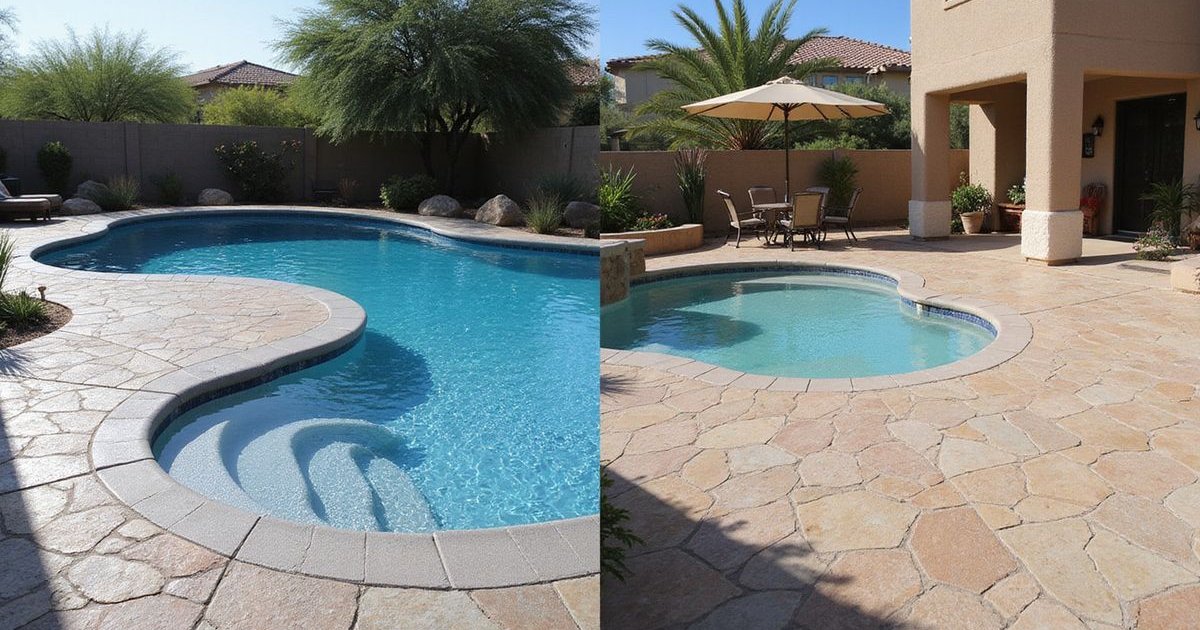
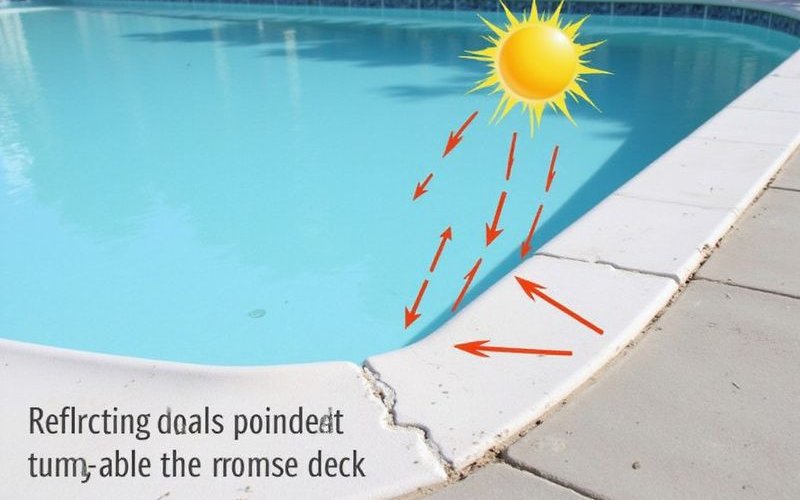
The primary driver of heat reduction is color and chemistry. Standard grey concrete absorbs heat, but acrylic cool deck toppings are engineered with pigments that reflect near-infrared radiation.
Data indicates that while grey concrete has an SRI of ~19, a light-colored cool deck coating can achieve an SRI of 40 to 60+. This higher value means the surface rejects more solar energy before it can be absorbed.
2. The “Bed of Nails” Texture Effect
The distinctive rough texture does more than prevent slips. We call this the “contact area” principle.
- Reduced Contact: The raised “lace” or “knockdown” texture means only about 40-50% of your foot actually touches the material.
- Air Circulation: The valleys between the texture allow air to flow under your soles, dissipating heat.
- Micro-Shading: The high points cast tiny shadows on the low points, slightly reducing solar gain on the surface itself.
3. Thermal Insulation Barrier
The coating material acts as a thin insulating layer. Even if the concrete slab underneath gets hot, the acrylic or cementitious topping transfers heat slower than raw concrete. This delay gives you enough time to walk across the deck without burning your feet.
Real-World Temperature Comparison (Phoenix Summer)
It is vital to have realistic expectations. We measure these surfaces regularly during Phoenix summers (115°F air temp).
| Surface Material | Surface Temperature | Est. Cost (2025 Phoenix) |
|---|---|---|
| Standard Grey Concrete | 150°F - 160°F | $0 (Existing) |
| Pavers (Dark/Red) | 145°F - 155°F | $10 - $20 / sq ft |
| Cool Deck (Acrylic Lace) | 125°F - 130°F | $4 - $8 / sq ft |
| Travertine (Light) | 110°F - 120°F | $15 - $30 / sq ft |
The data shows a clear hierarchy. Cool Deck isn’t as cool as premium Travertine, but it keeps the surface under the instant-burn threshold for a fraction of the cost.
Types of Cool Deck Products
Traditional Kool Deck (Keystone)
This is the original cement-based product invented in Tucson in the 1960s. We still see it on many older pools.
- Pros: Patented formula lowers temp effectively; breathable material.
- Cons: Harder to repair seamlessly; colors can fade significantly over 10+ years.
Acrylic Lace Overlay
Most modern “Cool Deck” jobs are actually acrylic overlays. Our crews prefer this for renovations because it bonds aggressively to old concrete.
- Pros: Highly customizable colors; flexible enough to bridge minor hairline cracks; resistant to pool chemicals.
- Cons: Can peel if installed on a dirty surface; slightly warmer than the original cement-based Kool Deck.
Elastomeric Coatings
These are thick, rubberized paints often sold as DIY solutions.
- Pros: Waterproof; covers cracks well.
- Cons: We often see these fail in Phoenix heat because they trap moisture, causing the coating to bubble and peel.

Critical Limitations & Maintenance
Cool Deck is a tool, not magic. You must understand its limits to be satisfied with the investment.
”Cooler,” Not Cold
A 125°F deck is still hot. You can walk on it, but you won’t want to sunbathe on the bare surface at 2 PM in July.
The Pressure Washer Warning
This is the most common way homeowners ruin their decks. Our repair team frequently fixes damage caused by high-pressure cleaning. Never use more than 1200-1500 PSI on a Cool Deck surface. Use a wide fan tip (40 degrees) to avoid chipping the texture.
Chemical Sensitivity
Magnesium and salt from modern chlorination systems can erode the surface over time. Rinse your deck regularly with a garden hose to prevent salt buildup.
Is Cool Deck Right for Your Pool?
We help hundreds of homeowners make this choice every year.
Choose Cool Deck if:
- You have a functional concrete deck that just looks ugly or feels hot.
- Your budget is between $4,000 and $8,000 (for an average pool).
- You need a quick turnaround (often 2-3 days).
Choose Stone or Pavers if:
- Your concrete is heaving, severely cracked, or structurally unsound.
- You want the absolute coolest surface possible (Travertine).
- You have a higher budget ($15,000+) and want a luxury look.
Professional Installation Matters
The difference between a 2-year lifespan and a 15-year lifespan is in the prep work. We follow a strict protocol that many budget contractors skip.
The Acid Etch is Non-Negotiable
The concrete must be “profiled” using muriatic acid to open the pores. Without this, the new coating has nothing to grab onto and will delaminate within a year.
Temperature Constraints
You cannot apply these products when the surface temp is over 100°F. Our crews often start at 4 AM in the summer to ensure the chemical bond forms before the heat spikes. Rapid drying leads to “delamination,” where the top layer flakes off like a sunburn.
Ready to make your deck comfortable? Call (602) 619-1234 to discuss your options and get a free assessment.
Tags
David Resurface
Pool resurfacing expert with over 15 years of experience in the Phoenix market. Passionate about helping homeowners transform their backyards into personal oases.